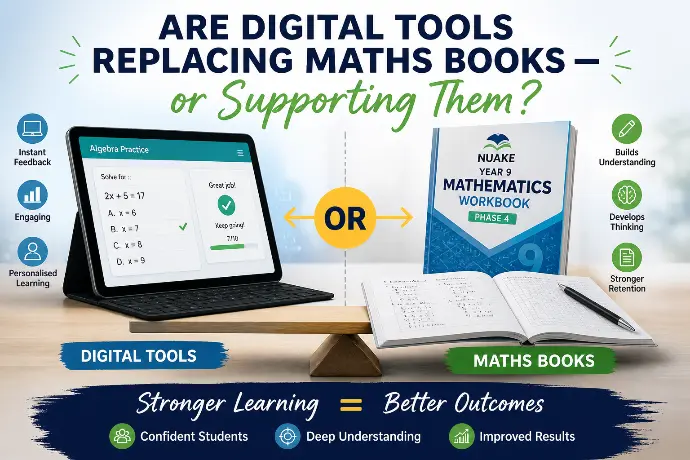
Are Digital Tools Replacing Maths Books - or Supporting Them?
In recent years, digital tools have rapidly become part of everyday classroom practice. From online platforms and apps to AI-powered learning systems, schools are increasingly investing in technology to support student learning.
But this raises an important question for maths educators:
Are digital tools replacing traditional maths books - or simply supporting them?
The answer, based on classroom experience and evidence, is clear, the most effective learning happens when both are used together.
The Rise of Digital Learning in Maths
Digital tools offer several clear advantages:
- Instant feedback for students
- Engaging, interactive content
- Easy differentiation for mixed-ability classes
- Access to a wide range of practice questions
For many students, particularly those who are digitally confident, these tools can increase motivation and provide additional practice opportunities beyond the classroom.
However, while digital tools are powerful, they are not a complete solution.
Where Digital Tools Fall Short
In maths education - students are not just learning to get answers. They are learning to:
- Structure working clearly
- Develop logical thinking
- Understand multi-step processes
- Build number sense
These are skills that require active thinking, not passive clicking.
Common challenges seen with digital-only approaches include:
- Students guessing answers through trial and error
- Weak written working and poor organisation
- Over-reliance on hints or auto-correction
- Limited development of problem-solving strategies
Without structured written practice, many students struggle to transfer skills into assessments.
Why Written Work Still Matters
Writing in maths is not just a way of recording answers, it is part of the learning process.
When students work through problems on paper, they:
- Slow down and think more carefully
- Make their reasoning visible
- Identify and correct their own errors
- Develop stronger retention of concepts
This is particularly important in areas like:
- Fractions, decimals, and percentages
- Multi-step problem solving
- Algebraic reasoning
- Financial mathematics
A well-structured workbook provides a clear pathway for students to practise and consolidate these skills.
The Best Approach: Blended Learning
Rather than choosing between digital tools and books, the most effective classrooms use both strategically.
A balanced model might look like:
- Workbooks for:
- Core skill development
- Structured practice
- Written working and consolidation
- Digital tools for:
- Reinforcement and extension
- Quick formative assessment
- Interactive revision
This approach combines the strengths of both methods, ensuring students develop both fluency and understanding.
Supporting Teachers, Not Adding Workload
Another key consideration is teacher workload.
While digital tools can provide data, they often require:
- Setup time
- Monitoring
- Interpretation
Workbooks, on the other hand:
- Provide ready-to-use structured content
- Allow quick visual checking of student understanding
- Support consistent delivery across classes
When used together, teachers can maintain clarity, consistency, and efficiency in their programmes.
What This Means for Classrooms
In classrooms, where student needs and abilities vary widely, flexibility is essential.
A blended approach allows teachers to:
- Support diverse learners
- Maintain curriculum alignment
- Build strong foundational skills in number
This foundation is critical for future success in mathematics.
Final Thoughts
Digital tools are not replacing maths books.
They are enhancing what good teaching already looks like.
The most successful classrooms are not fully digital or fully traditional - they are thoughtfully balanced.
By combining structured written practice with targeted digital support, schools can ensure students develop:
- Confidence
- Accuracy
- Deep understanding 🌈✨