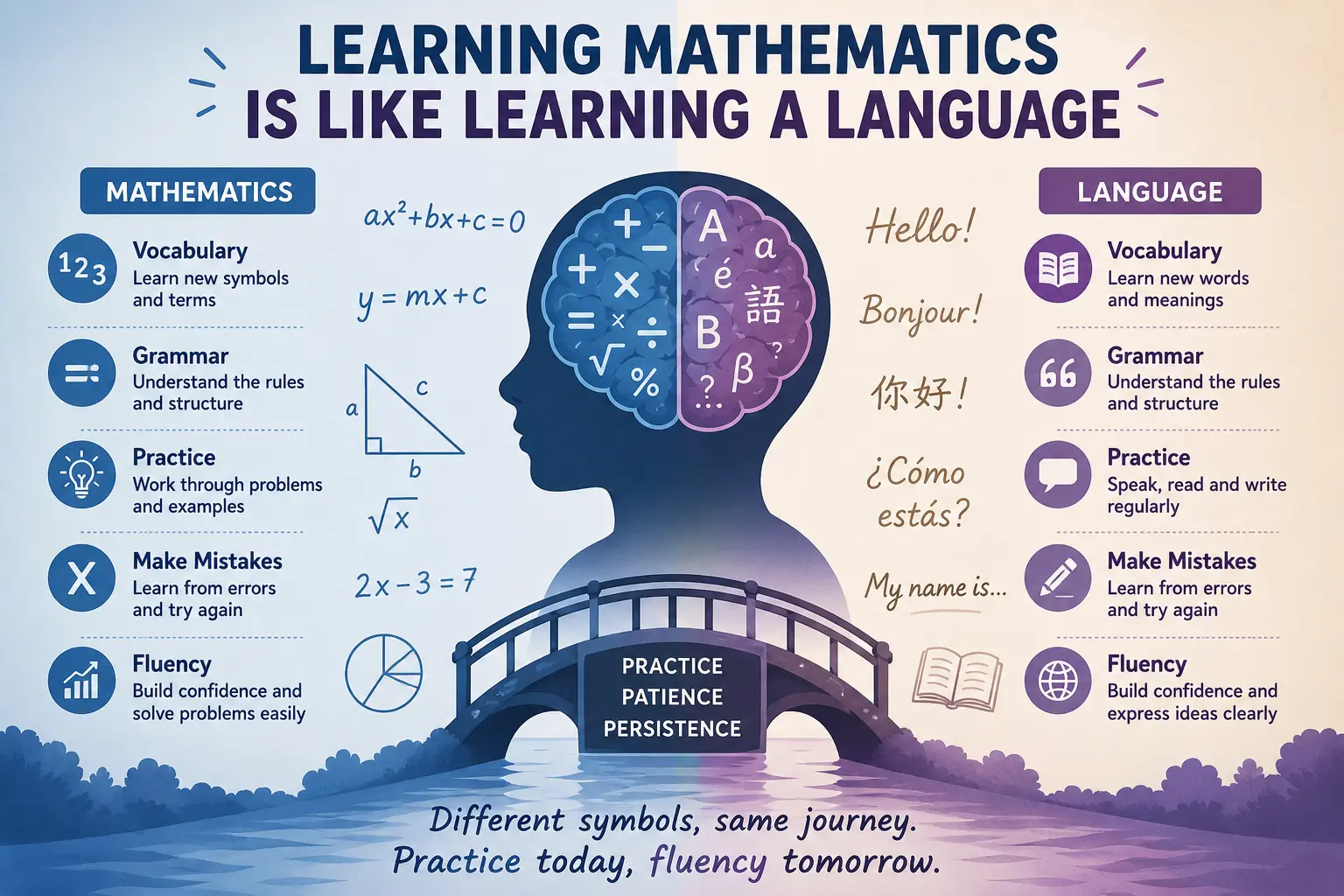
Learning Mathematics Is Like Learning a Language
When people think about learning a language, they immediately understand that it takes time, practice, and patience. No one expects to become fluent in French, Spanish, or Japanese after attending a few lessons.
Yet many students expect mathematics to be different.
They think they should understand a new topic after seeing it explained once. When they don't, they often conclude that they are "just not good at maths."
The truth is that learning mathematics has far more in common with learning a language than most people realise.
Mathematics Has Its Own Vocabulary
Every language has words that carry precise meanings. Mathematics is no different.
Students encounter terms such as:
- coefficient
- factor
- variable
- probability
- gradient
- median
- equation
- function
At first these words seem unfamiliar, just as vocabulary does in a new language. Over time, however, repeated exposure allows students to understand and use them naturally.
One of the biggest obstacles to learning mathematics is simply not understanding the language that mathematicians use.
Mathematics Has Grammar Too
Words alone don't make a language. They must be arranged according to rules.
Mathematics has its own grammar.
For example:
- Operations follow a particular order.
- Equations must remain balanced.
- Algebra follows logical rules.
- Geometric proofs require structured reasoning.
Just as you cannot place words in any order when speaking English, you cannot rearrange mathematical expressions without following the correct rules.
Learning these patterns takes practice.
Fluency Comes Through Use
Nobody learns to speak another language by only reading a textbook.
They must speak, listen, read, write, make mistakes, and try again.
Mathematics works exactly the same way.
Students develop fluency by:
- solving problems
- explaining their thinking
- checking their answers
- correcting mistakes
- practising regularly
Watching someone else solve a problem is useful, but it is only the beginning. Real understanding develops when students work through problems for themselves.
Mistakes Are Part of Learning
Children learning their first language make countless mistakes.
They pronounce words incorrectly.
They use the wrong grammar.
They confuse similar words.
Nobody sees these mistakes as failure - they are simply part of learning.
The same is true in mathematics.
Every incorrect answer provides valuable information. It highlights a misunderstanding that can be corrected, making the student's understanding stronger than before.
Students who are afraid of making mistakes often learn more slowly than those who are willing to have a go.
Practice Builds Confidence
Think about learning to play a musical instrument.
Or learning to drive a car.
Or learning a new language.
Confidence doesn't appear overnight. It grows with practice.
Mathematics is no different.
Regular, manageable practice helps students recognise patterns more quickly and solve problems with greater accuracy.
Over time, concepts that once seemed difficult become almost automatic.
Immersion Helps
People often learn languages more quickly when they are surrounded by them every day.
Mathematics also benefits from regular exposure.
Students who spend a little time each day working with numbers, graphs, formulas, and problem-solving develop stronger mathematical thinking than those who only study occasionally.
Consistency is far more effective than trying to learn everything the night before a test.
Every Topic Builds on Previous Learning
Languages build one lesson upon another.
You learn simple words before complex sentences.
You master basic grammar before writing essays.
Mathematics follows the same pattern.
Students need confidence with:
- number facts
- fractions
- decimals
- percentages
before moving comfortably into algebra, trigonometry, probability, and calculus.
When the foundations are secure, new ideas become much easier to learn.
The Importance of Regular Practice
Just as language skills fade when they are not used, mathematical skills also become rusty without practice.
Short, regular study sessions are usually far more effective than occasional long ones.
Working through a variety of examples, answering questions independently, and reviewing previous topics all help move knowledge from short-term memory into long-term understanding.
A Different Way of Thinking
Perhaps the greatest similarity between mathematics and language is that both teach us how to think.
Languages allow us to communicate ideas.
Mathematics allows us to communicate logical reasoning.
Both require precision.
Both reward persistence.
Both become easier the more we use them.
Final Thoughts
Learning mathematics is not about being born with a special talent. It is about gradually becoming fluent in a new way of thinking.
Like learning any language, success comes from regular practice, making mistakes, asking questions, and building confidence one step at a time.
The students who become successful in mathematics are rarely those who never struggle. They are the ones who keep practising, keep learning from their mistakes, and keep adding new "words" and "grammar" to their mathematical vocabulary.
Mathematics is a language that opens doors - to science, engineering, technology, finance, medicine, and countless everyday decisions.
The more fluent you become, the more opportunities you create for yourself. 🌈✨