What Makes Mathematics Different from Other Subjects?
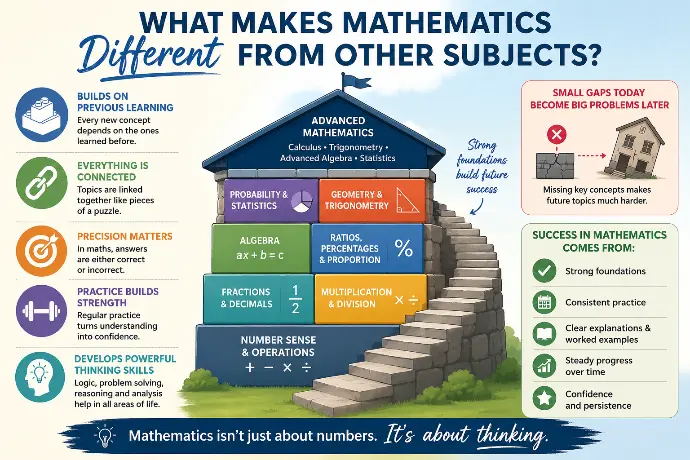
Mathematics is unlike any other subject taught at school. While subjects such as history, geography, science and English all develop valuable knowledge and skills, mathematics has one unique characteristic: every new concept builds upon previous learning. If a student has gaps in their understanding, those gaps tend to grow as the mathematics becomes more advanced.
This cumulative nature is one of the reasons why some students thrive in mathematics while others begin to lose confidence. Fortunately, it also explains why regular practice and steady progress can make such a difference.
Mathematics Is Like Building a House
Imagine constructing a house.
You wouldn't start building the roof before laying the foundations. Each stage depends on the one before it. If the foundations are weak, the entire structure becomes unstable.
Mathematics works in much the same way.
Students first learn to:
- count and recognise numbers,
- add and subtract,
- multiply and divide.
These skills are then used to learn:
- fractions,
- decimals,
- percentages,
- ratios,
- algebra,
- geometry,
- statistics,
- probability,
- and eventually calculus.
Every topic depends on skills learned earlier.
For example, a student who struggles with fractions will often find algebra, probability and measurement much more difficult because fractions appear throughout these topics.
Knowledge Doesn't Stand Alone
In many school subjects, topics can often be studied independently.
A student might study:
- Ancient Egypt,
- World War II,
- the Industrial Revolution,
without needing detailed knowledge of every historical period in between.
Similarly, in geography students may study volcanoes one term and population growth the next.
Mathematics is different.
Learning linear equations depends on understanding negative numbers.
Graphing requires knowledge of coordinates.
Trigonometry relies on geometry.
Probability often requires fractions and percentages.
Every topic is connected.
There Is Usually One Correct Answer
Another feature that makes mathematics unique is its precision.
Many subjects encourage discussion and different viewpoints.
In mathematics, however, a calculation is either correct or it isn't.
That doesn't mean there is only one way to solve a problem. In fact, mathematicians often enjoy discovering different methods. But whichever method is chosen, it should lead to the same correct result.
Learning to justify solutions and explain reasoning is just as important as finding the answer.
Practice Really Does Matter
People often ask whether some students are simply "good at maths."
Research suggests that confidence and regular practice play a much bigger role than many people realise.
Like learning a musical instrument or playing a sport, mathematics improves through repetition.
Each question solved reinforces previous learning.
Each worked example helps students recognise patterns.
Each homework exercise strengthens understanding.
The more often students retrieve knowledge from memory, the easier it becomes to use that knowledge in new situations.
Small Gaps Become Large Gaps
Because mathematics is cumulative, missing one concept can have long-term consequences.
A student who never fully understands percentages may later struggle with:
- probability,
- financial mathematics,
- statistics,
- interpreting graphs,
- growth and decay.
Similarly, weak algebra skills make later work with functions, graphs and calculus much more challenging.
The good news is that these gaps can usually be filled through targeted revision and practice before they become major obstacles.
Confidence Grows Through Success
Many students lose confidence because they experience repeated failure.
Successful mathematics learning is built on carefully sequenced questions that allow students to experience regular success while gradually increasing the level of challenge.
Well-designed examples followed by progressively more demanding exercises help students develop both competence and confidence.
This is one reason why structured mathematics resources remain so valuable. They provide a logical pathway that supports students as they build new skills.
Mathematics Develops Ways of Thinking
While mathematics teaches numbers and formulas, its greatest value may lie elsewhere.
Students learn to:
- analyse information,
- recognise patterns,
- think logically,
- solve unfamiliar problems,
- justify conclusions,
- check whether answers are reasonable.
These are skills that extend well beyond the mathematics classroom and are valuable in science, engineering, business, technology and everyday decision-making.
Final Thoughts
Mathematics is different because it is a subject where every new idea builds on earlier understanding. Strong foundations lead to greater confidence, while gaps in learning can make future topics more difficult.
The encouraging news is that success in mathematics rarely depends on natural talent alone. Regular practice, clear explanations, worked examples and carefully structured learning allow students to strengthen their understanding one step at a time.
Like building a house, mathematics is strongest when every layer is built on solid foundations. Invest time in mastering today's concepts, and tomorrow's learning becomes far easier.
At NuLake, we believe effective mathematics resources should reflect the way students learn. Clear explanations, fully worked examples, carefully graded exercises and regular revision all help students build the strong foundations they need to succeed -not just in the next test, but throughout their mathematical journey. 🌈✨