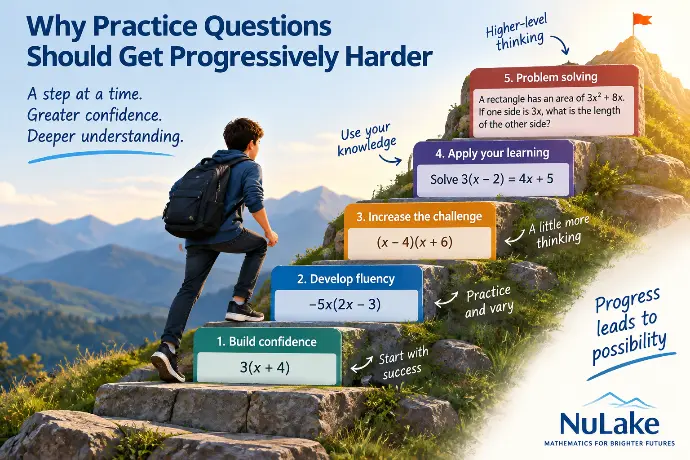
Why Practice Questions Should Get Progressively Harder
Learning mathematics is not simply about completing lots of questions. The order in which those questions are presented matters.
A well-designed set of mathematics exercises should take students on a journey. It should begin with questions that allow them to practise a new skill, then gradually introduce greater complexity, and finally challenge them to apply what they have learned in less familiar situations.
This is why practice questions should get progressively harder.
Start by Building Confidence
When students first meet a new mathematical concept, they need an opportunity to concentrate on the new skill without being distracted by unnecessary complexity.
Imagine a student who has just learned how to expand brackets. It makes sense to begin with something straightforward such as:
3(x+4)
before expecting them to deal with:
−5x(2x−3)
or a problem in which they first have to decide that expanding brackets is the appropriate method.
Those first questions are important. They allow students to become familiar with the process and experience early success.
But that is only the beginning.
From Understanding to Fluency
Once a student understands a mathematical method, they need practice to become fluent in using it.
This is similar to learning a musical instrument. Understanding where the notes are on a piano does not mean you can immediately play a piece of music. Repetition develops fluency.
Mathematics works in much the same way.
A student may understand an example perfectly when a teacher demonstrates it, but independent practice is what reveals whether they can actually use the method themselves.
The aim is not endless repetition of identical questions. Instead, questions should gradually vary the numbers, signs, notation and situations while continuing to reinforce the underlying mathematical idea.
Then Increase the Challenge
Once the basic skill is established, the questions should become more demanding.
A carefully structured exercise might progress through:
basic skill → variation → greater complexity → application → problem solving
At each stage, the student has to do a little more thinking.
This progression is important because mathematics in the real world rarely announces which method should be used. A textbook exercise headed “Solve these equations” has already given the student an important piece of information: use equation-solving techniques.
A more challenging problem requires the student to recognise for themselves that an equation needs to be formed and solved.
That is a much higher level of mathematical thinking.
Hard Questions Too Soon Can Be Counterproductive
Starting with questions that are too difficult can create a different problem.
A student who is still trying to understand a new method may encounter several difficulties simultaneously. They may have to deal with negative numbers, fractions, unfamiliar notation and several mathematical steps while still trying to remember the basic procedure.
If they continually get questions wrong, they may conclude that they simply cannot do the mathematics.
Often the problem is not the student's ability. The size of the jump was simply too great.
Good progression creates smaller steps between levels of difficulty.
But Easy Questions Alone Are Not Enough
There is an opposite problem.
If every question looks almost identical to the example immediately above it, students can become very good at copying a procedure without developing a deeper understanding of what they are doing.
For example, after completing ten almost identical percentage questions, a student may appear to have mastered percentages. Change the wording, combine percentages with another concept or place the mathematics inside a practical situation, and suddenly the same student may not know what to do.
This reveals an important distinction:
Being able to repeat a method is not the same as being able to apply it.
Students need both.
Good Questions Create a Learning Path
A strong mathematics exercise therefore has a deliberate structure.
The first few questions establish the skill. The next questions introduce variations. Later questions require more steps or combine the skill with previous learning. The most challenging questions require students to interpret information, choose an appropriate strategy and apply their mathematics independently.
The student is not being thrown straight into the deep end. Neither are they being kept permanently in the shallow end.
They are being gradually taught to swim.
This Is the Approach Behind NuLake Workbooks
This progression is an important part of the way NuLake Mathematics Workbooks are structured.
Rather than simply presenting collections of unrelated questions, the workbooks combine notes, detailed worked examples and a large number of graded problems on each concept. The aim is to give students the support they need when a concept is introduced, followed by practice that develops their skills and increasingly challenges their mathematical thinking.
The NuLake Homework Books use a similar philosophy. A page typically focuses on a particular mathematical concept, provides examples, moves through straightforward reinforcement questions and then includes practical application or communication problems requiring higher-level skills.
For New Zealand students and schools, explore the range of workbooks and homework books at NuLake New Zealand.
For students, parents and teachers outside New Zealand, the digital range is available through NuLake International. The international workbooks include graded problems and are designed for students across a range of year levels, with resources that can be matched to the appropriate level of challenge.
Progress, Not Just Practice
The best mathematics practice is not about doing 50 versions of the same question.
It is about progression.
Start with something achievable. Build fluency. Introduce variation. Increase the difficulty. Then ask students to apply what they know in situations where the solution is not immediately obvious.
That is when practice becomes more than repetition.
It becomes learning. 🌈✨