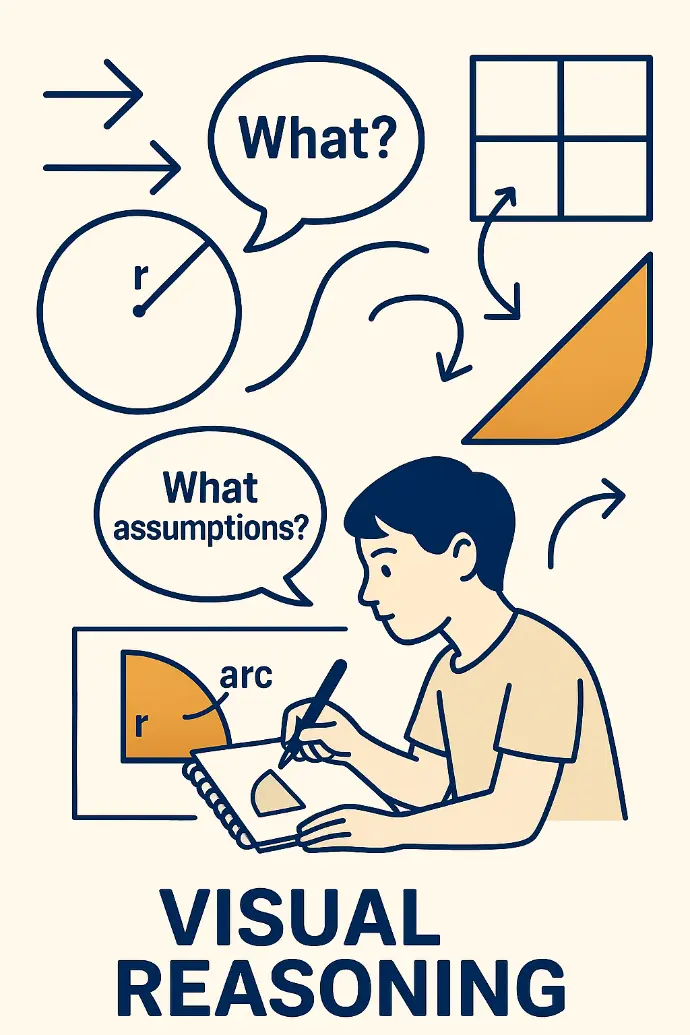
Why Visual Reasoning Matters
Visual reasoning strengthens mathematical understanding in several ways:
- It reduces cognitive load by organising information spatially.
- It reveals patterns and structures that may be hidden in symbolic form.
- It supports students who struggle with purely numerical or algebraic approaches.
- It encourages explanation, justification, and communication - essential parts of mathematical thinking.
When students draw, annotate, and interpret diagrams, they’re not just decorating their work. They’re building meaning.
How Diagrams Support Understanding Across Topics
Geometry
Geometry is naturally visual, but diagrams do more than show shapes - they help students reason about them. A labelled sketch of a composite shape, for example, helps students identify which lengths contribute to the perimeter and which areas need to be added or subtracted.
Algebra
Visuals make algebra less abstract. Tables, graphs, and pattern diagrams help students see how quantities change together, making concepts like linear relationships or sequences far more intuitive.
Number
Number lines, arrays, and area models help students understand operations, fractions, and proportional reasoning. A number line showing the distance between −3 and 4 communicates more than a symbolic subtraction ever could.
Statistics
Graphs and visual displays allow students to interpret data, spot trends, and compare distributions. A well‑constructed dot plot or histogram can turn raw numbers into a story.
Types of Diagrams That Build Strong Mathematical Thinking
- Sketches of real situations - garden beds, ramps, paths, containers
- Geometric diagrams - labelled shapes, arcs, nets, transformations
- Number lines - operations, fractions, inequalities
- Tables and grids - patterns, ratios, functions
- Graphs - relationships, change, comparisons
- Flow diagrams - reasoning steps, logic, multi‑stage problems
Each type supports a different kind of thinking, and students benefit from learning when and why to use them.
Classroom Strategies That Encourage Visual Reasoning
• Sketch First
Before calculating, students sketch the situation. This helps them identify what’s known, what’s missing, and what the problem is really asking.
• Label Everything
Encouraging students to label lengths, angles, axes, or key points helps them connect the visual to the mathematics.
• Compare Representations
Show two different diagrams for the same problem and ask: Which one helps you more? Why? This builds metacognitive awareness.
• Explain the Diagram
Students describe what their diagram shows and how it helps them solve the problem. This turns a picture into reasoning.
• Use Diagrams to Check Answers
A quick sketch can reveal whether an answer is reasonable - especially in measurement, algebra, and statistics.
Why Visual Reasoning Helps All Learners
Visual reasoning:
- Supports students who think spatially or visually
- Helps English‑language learners by reducing reliance on text
- Encourages deeper understanding rather than memorisation
- Builds confidence by giving students an accessible entry point
- Makes complex problems feel manageable
When students learn to use diagrams as thinking tools, they become more flexible, independent problem‑solvers.
Final Thoughts
Mathematics is not just numbers and symbols - it’s a language of patterns, shapes, and relationships. Diagrams help students access that language. They make thinking visible, support reasoning, and turn abstract ideas into something concrete.
Visual reasoning isn’t an add‑on. It’s a core part of learning mathematics well. 🌈✨