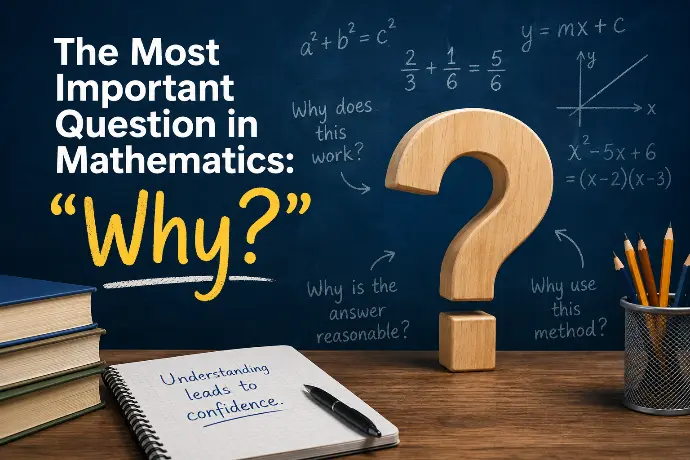
The Most Important Question in Mathematics is: "Why?"
Mathematics is often taught as a subject full of rules: multiply these numbers, move this term to the other side, use this formula, change this fraction to a decimal, substitute these values.
Knowing what to do is certainly important. But there is another question that can turn mathematics from a collection of rules into something that actually makes sense:
Why?
Why does this method work? Why do we use this formula? Why does multiplying two negative numbers give a positive answer? Why do we invert a fraction when dividing by it? Why does changing one number in an equation change the graph?
Students who regularly ask “why?” are doing more than learning how to get answers. They are learning to think mathematically.
Knowing the Rule Is Not the Same as Understanding It
Consider a student learning to divide fractions. They may be taught:
To divide by a fraction, turn the second fraction upside down and multiply.
The student can memorise the rule and successfully calculate, but why do we turn the second fraction upside down?
If students never consider that question, the procedure can become just another rule to remember. And mathematics contains a lot of rules.
Understanding why a method works gives the rule meaning. Meaning makes it easier to remember, easier to apply and, importantly, easier to adapt when a problem looks slightly different.
“Why?” Builds Connections
Mathematics is not a collection of unrelated topics. New ideas are constantly connected to things students have learned previously.
Percentages are connected to fractions and decimals. Algebra builds on arithmetic. Gradient connects algebra with geometry. Probability uses fractions, decimals and percentages. Compound interest combines percentages with repeated multiplication.
Asking “why?” helps students discover these connections.
For example, why does increasing an amount by 15% mean multiplying it by 1.15?
Because the new amount consists of:
100% + 15% = 115%
and
115% = 1.15
The multiplier 1.15 is no longer an arbitrary number that a student has been told to use. It has a reason.
That small difference - between remembering a number and understanding where it came from - is important.
“Why?” Helps When You Forget
Everyone forgets mathematical rules occasionally.
The problem with learning mathematics entirely through memorisation is that once a rule has been forgotten, there may be nothing left to fall back on.
Understanding provides a way back.
A student who understands where a rule comes from can often reconstruct it. They may not remember the exact procedure immediately, but they understand enough of the mathematics to work it out.
That is a much stronger foundation than relying on memory alone.
“Why?” Helps Students Spot Mistakes
Understanding also gives students something extremely valuable: a sense of whether an answer is reasonable.
Suppose a $200 item is reduced by 25% and a calculator gives an answer of $250.
A student who is simply following keystrokes may accept the result.
A student who understands what a 25% reduction means should immediately ask:
Why has the price gone up when it was supposed to decrease?
That question can reveal a calculator error, an incorrect operation or a misunderstanding of the problem.
Strong mathematics students do not simply calculate an answer. They question the answer.
“Why?” Is at the Heart of Problem Solving
Routine exercises usually tell students, either directly or indirectly, what mathematical method they are expected to use.
Real problem solving is different.
The student must decide:
- What information is important?
- What mathematics could I use?
- Why is that method appropriate?
- Does my answer make sense?
- Is there another way of solving the problem?
This is why a student can sometimes complete a page of routine exercises successfully but struggle with an application problem involving exactly the same mathematics.
The difficulty is no longer simply carrying out the procedure. It is deciding why and when to use it.
Asking “Why?” Does Not Mean Every Rule Has to Be Proved
There is a balance.
Students do not need to derive every formula from first principles every time they use it. Once a concept is understood, becoming fluent with the method is important too.
The aim is not to replace mathematical practice with endless explanation.
Instead, students should develop the habit of asking questions such as:
Why does this work?
Why am I using this method?
Why is my answer reasonable?
Why did this approach fail?
Why is this problem different from the previous one?
Those questions encourage understanding alongside fluency.
Teachers Can Encourage the Question
One of the simplest ways to develop deeper mathematical thinking is to occasionally turn a question around.
Instead of only asking:
“What is the answer?”
ask:
“Why?”
Why did you choose that operation?
Why can those terms be combined?
Why can't these two terms be combined?
Why must the inequality sign change direction?
Why do you think your answer is correct?
A correct answer tells us that a student may know how to perform a process. An explanation often tells us whether they understand the mathematics behind it.
Mathematics Should Make Sense
There will always be facts, terminology, formulas and procedures that students need to learn. Practice is also essential. Mathematics cannot be learned simply by understanding ideas in theory - students need to use those ideas repeatedly until important skills become familiar.
But practice is much more powerful when it is supported by understanding.
At NuLake, our mathematics resources are structured around this principle: explanation, worked examples, practice, application and problem solving. Students first see how an idea works, then practise the skill and finally apply their understanding in increasingly demanding situations.
Because the ultimate goal of learning mathematics is not simply to know what to do.
It is to understand why. 🌈✨