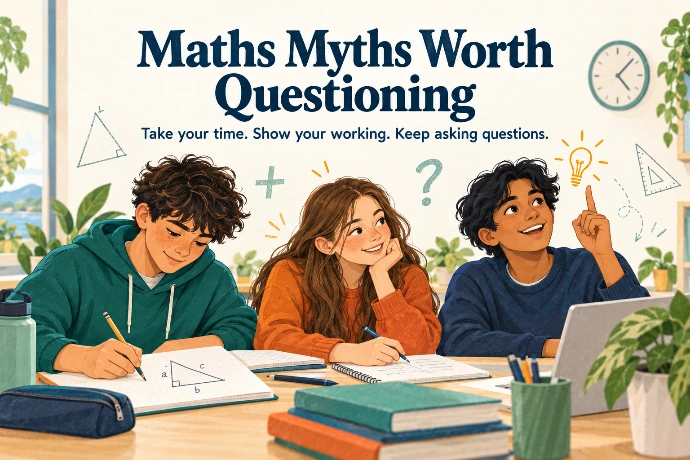
Maths Myths Worth Questioning
Do you have to be fast to be good at maths? Does getting stuck mean you are no good at it? It is time to question a few familiar maths myths.
The things we believe about maths can affect how we approach it. If we think success means answering instantly or never making a mistake, it is easy to feel discouraged.
But there is much more to maths than speed and correct answers. Taking time, trying different approaches and learning from mistakes are all part of developing your skills.
Myth 1: “You have to be fast to be good at maths.”
A quick answer can be useful, but speed is only one part of maths. Reading carefully, choosing a suitable method and explaining your reasoning matter too.
Someone who takes longer may be checking an assumption, drawing a diagram or working through several steps. These are useful mathematical habits.
Try this: Focus first on finding a method you understand and can explain. Build confidence with that method before worrying about speed.
Myth 2: “Some people are maths people, and others are not.”
It can seem this way when someone else finds a topic easy. What you cannot always see is their previous practice, the help they have received or the topics they find difficult.
Finding algebra tricky does not mean you cannot learn it. You may need to revisit an earlier skill, see another example or have the idea explained differently.
Try this: Replace “I am no good at maths” with something specific, such as “I need more practice solving equations with brackets.” A specific difficulty gives you something to work on.
Myth 3: “Making mistakes means I am failing.”
A mistake gives you something useful to investigate. Did you misunderstand the question, choose the wrong operation or lose a negative sign?
Simply copying the correct answer misses that opportunity. Finding where your working went wrong helps you decide what to do differently next time.
Try this: Correct the step where the error occurred, then attempt a similar question on your own.
Myth 4: “Getting the right answer is all that matters.”
The answer matters, but your working shows how you reached it. Clear steps help you check your reasoning and make it easier for someone else to offer useful feedback.
A correct answer reached by guessing may also hide a gap in understanding.
Try this: Ask yourself, “Could someone follow my method without me explaining it aloud?”
Myth 5: “If I understand the example, I can do it myself.”
Following a worked example is a useful start. Choosing and carrying out the steps independently is the next challenge.
A method can look obvious while it is in front of you, then feel much less familiar when you turn the page.
Try this: Study an example, cover the working and attempt a similar question. Afterwards, compare the methods and revisit any steps you missed.
Myth 6: “If I get stuck, I should give up.”
Getting stuck is a cue to pause and consider another approach. You could sketch a diagram, write down what you know, try simpler numbers or look back at a related example.
Asking for help is useful too - especially when you can explain what you have already tried.
Try this: Instead of saying “I cannot do it”, ask, “What could I try next?”
Give yourself room to learn
You do not need to answer first or get everything right straight away. Aim to understand a little more, explain your thinking clearly and learn from each attempt.
NuLake workbooks provide opportunities for written practice, while NuLake eFlip Cards offer a quick memory jog of familiar topics. Try a question before flipping to the worked solution, then compare it with your own approach. 🌈✨